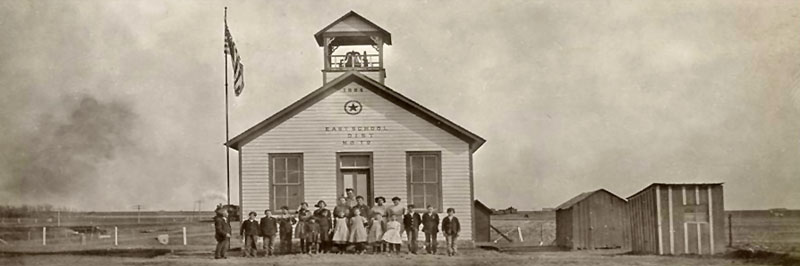
My great-grandmother taught in a one-room schoolhouse, and my grandmother, in another, was once a child on its benches. When my grandmother told me about hers years later, I pictured the version I'd seen on television — the long skirt, the bell rung by hand at recess. I doubt anyone is nostalgic for that school; the world it served was poorer than ours. But it built something we have not matched: for most of the late nineteenth and twentieth centuries, America had the most successful mass-education system on earth — the engine, economists say, behind much of its prosperity.
That system had a few things we have spent fifty years undoing.
First, the people who paid for that school mostly ran it, and had to live with the result. Decisions got made close to the ground — close to the parents, the teacher, the child — and when something went wrong, you knew whose door to knock on, because it was just down the road. Second, schools competed: a town with a better school drew families from a town with a worse one, the way towns once competed for a rail line. As decisions drifted upward and away, the competition went with it.
Last week I wrote about where Kansas school money goes — to administration, to overhead, to nearly everything except the classroom. This essay asks the question underneath: why does the administrative side grow every year, no matter who holds office? The answer begins with what replaced that one-room school.
That school was, for its era, as good as existed anywhere, and as it grew it only got better: from 1910 to 1940 the share of American teenagers in high school climbed from 18% to 71%, and the share who graduated went from under a tenth to better than half. It happened town by town, under boards that answered to the parents down the road — built the way we built everything else then, locally, by the people who had to live with the result.
Then, around 1970, the center of gravity moved — not because anyone meant harm, but because every problem produced a program. Washington took a larger role, the states piled on mandates, and the grants arrived, each carrying a condition, each condition a report, each report someone hired to file it. The layers only accumulated, and decision-making drifted away from the schoolhouse toward offices in Topeka and Washington no parent could find.
This was obvious by the early 1980s, when Reagan made undoing it his project. By then dozens of separate federal grants had become hundreds, each carrying its own conditions and reports. His case was that authority and accountability belong together — the money should follow responsibility, not bureaucracy — so he folded the largest of them into block grants and handed the money back to the states with fewer strings. It did not hold. By the 1990s there were more grant programs than when he took office, and the strings had grown back. Reagan fought the ratchet harder than any president before or since, and the ratchet won anyway.
The mismatch he fought is still with us. Barely a dime of every dollar Kansas spends on its schools comes from Washington, and yet a much larger share of the rules a Kansas school must obey originates there. Special education is the clearest case. Washington requires every district to provide it and promised in 1975 to cover 40% of the added cost. It never has — today it covers about 13%. Washington wrote the mandate. Washington underfunds it. Kansas absorbs the rest, year after year, having voted on neither.
The pull runs deeper than any single mandate, because the incentive is built into the money itself. When reimbursement follows a category rather than a child, a system spends more and more of its time identifying categories, documenting that it qualified, and protecting the funding stream once it has it. That is not corruption; it is just how incentives work.
My great-grandmother never filed a compliance report. She did not need one. The only question that mattered in her schoolroom was whether the child in front of her was learning, and she could answer it herself, every day, by looking. Everything built since was meant to help answer that question better. But so much has been built that the system has lost track of the question it's supposed to answer.
"The only question that mattered in her schoolroom was whether the child in front of her was learning. So much has been built that the system has lost track of the question it's supposed to answer."
— Josh Dambacher
Every one of those rules seemed reasonable, or at least defensible, the day it was written. And each rests on the same asymmetry: a concentrated benefit for someone in particular — the reading coach, the testing vendor, the compliance consultant — and a cost spread so thin across everyone else that no one bothers to fight it. The child who needs another adult in the classroom rarely has anyone paid to argue his side. Undoing any of it would mean a legislator standing up to propose limiting a rule that protects disabled children, or tracks a dollar, or guards against a thing that once went wrong — the headline writes itself, and so does the thirty-second ad, and neither is kind. So the rule stays, defended by the few it pays and forgotten by the many it costs, and the next reform lands on top of it. Thirty years of additions like this, not one subtraction, and you arrive where Kansas has arrived: a system that swelled its management ranks by a third while the number of children barely moved. The ratchet isn't a conspiracy. It's just that removing a rule is a job that punishes whoever takes it and rewards no one — so no one takes it.
"Removing a rule is a job that punishes whoever takes it and rewards no one — so no one takes it."
— Josh Dambacher
This is how the choice gets made: a rule's benefit is collected once, the day it passes, and its cost is paid forever after, never measured again. The waste is not a slab of fat on the edge of the steak. It is marbled all the way through — a position here, a report there, no single piece worth the fight, the whole of it costing a fortune.
Two forces drive it, and we mistake them for one. The first is compliance: obeying the law takes people. The second is quieter — we keep handing schools work that used to belong to someone else. It feeds the child breakfast and lunch, sometimes what he carries home for supper; it screens his eyes, his teeth, his moods, the anxiety the phone in his pocket brings to school. Each new task is an act of mercy, and each also needs a coordinator. A school asked to do everything will, in time, hire someone to administer everything, and lose a little more of its purpose with each thing it takes on.
I am not describing other people's children. I carried the ticket for free breakfast and lunch. A school nurse screened my eyes and gave me fluoride once a month; a PE teacher caught the curve starting in my spine in time to do something about it. I am, in part, a product of the school doing more than teaching, and I will not pretend the mercy was wrong. But notice what we have never once done: we have never stopped to decide what a school is for. A thing asked to do everything, for everyone, forever, will hire and hire and hire — and teach a little less each year. The point is not that schools should stop feeding hungry children, but that a mission with no edges is a budget with no bottom.
Read First — The Plains Ledger, Essay 1 of 3
The Money Never Reached the Classroom.
Kansas spends $18,324 per pupil — among the ten highest in the country. The question is not whether Kansas spends enough. The question is where the money goes.
Read the essay →
None of that is the teacher's fault, and most of it is not even the administrator's. They are running a building the rest of us keep handing new missions and never relieving of an old one. Walk the org chart of a Kansas district and you find jobs that did not exist when my great-grandmother stood at the front of her room: a homeless-student liaison, a federal-programs director, a wellness coordinator, a compliance officer, a grants administrator. The homeless liaison exists because federal law requires districts to find homeless children and get them to school, and a child sleeping in a car shouldn't lose his seat in class too. The need is real — but no one will ever propose that homeless children go uncounted, so the position, once created, is never removed. Each line was added for a reason, and that is exactly why none ever comes out. Then it multiplies sideways. Every one of those mandates lands on all of Kansas's nearly three hundred districts at once, and each builds its own machinery to obey it — its own back office of compliance and procurement and payroll and reporting, even where it could share one. We call that local control. It is closer to the opposite: three hundred back offices, each obeying the same manual none of them wrote. We centralized the rules and decentralized the bureaucracy, and got the worst of both.
So what do you do about a ratchet? Not a freeze — a freeze only locks the pile in place. You do the one thing government almost never does: you give someone the job of subtraction, and you make every rule answer for itself before it gets to keep going.
Kansas reviews its rules — since 2022 it's even required to, every five years. But a review is not a sunset. Nothing expires on its own; the rule stays unless someone affirmatively kills it, and the first round of reviews killed almost nothing. Kansas was even offered a true sunset in 2019 — regulations lapsing after five years unless the legislature voted to keep them — and declined it. The burden stays on the reformer to prove a rule should go, never on the rule to prove it should stay.
My great-grandmother's schoolhouse is no model for the future; the world is too big and tangled now for one room and one teacher. But it kept faith with a principle we abandoned without quite deciding to: that the decision should sit as close as it can to the child it falls on. We did not lose that in a single act. It drifted, one small addition at a time, until the choices once made down the road got made in Topeka and Washington — by people no parent could find.
The cynic says this cannot be undone — that bureaucracies only grow, that the ratchet has no reverse. He is right only if no one takes the job he calls impossible. But the responsibility never vanished; it was only divided until it sat everywhere and nowhere, and no one answered for it. It is still there, on the ground, where someone left it, and anyone may pick it up.
Next week in The Plains Ledger: what Kansas can actually do about it — not how much it spends, but whether, at the end of it all, a child can read, and who, by name, can be made to answer for him. The question is no longer whether Kansas can afford another reform. It is whether it can finally find the discipline to remove one.
Josh Dambacher is a fifth-generation Kansan who attended public schools in Kansas, is on the Board of Literacy Partners, and writes The Plains Ledger.
— J.D.