Kansas Education & Fiscal Policy
New · July 2026
Essay 3 of 3
Measure What Matters.
Kansas fell from 5th to 36th in reading. Here’s how to reverse it.

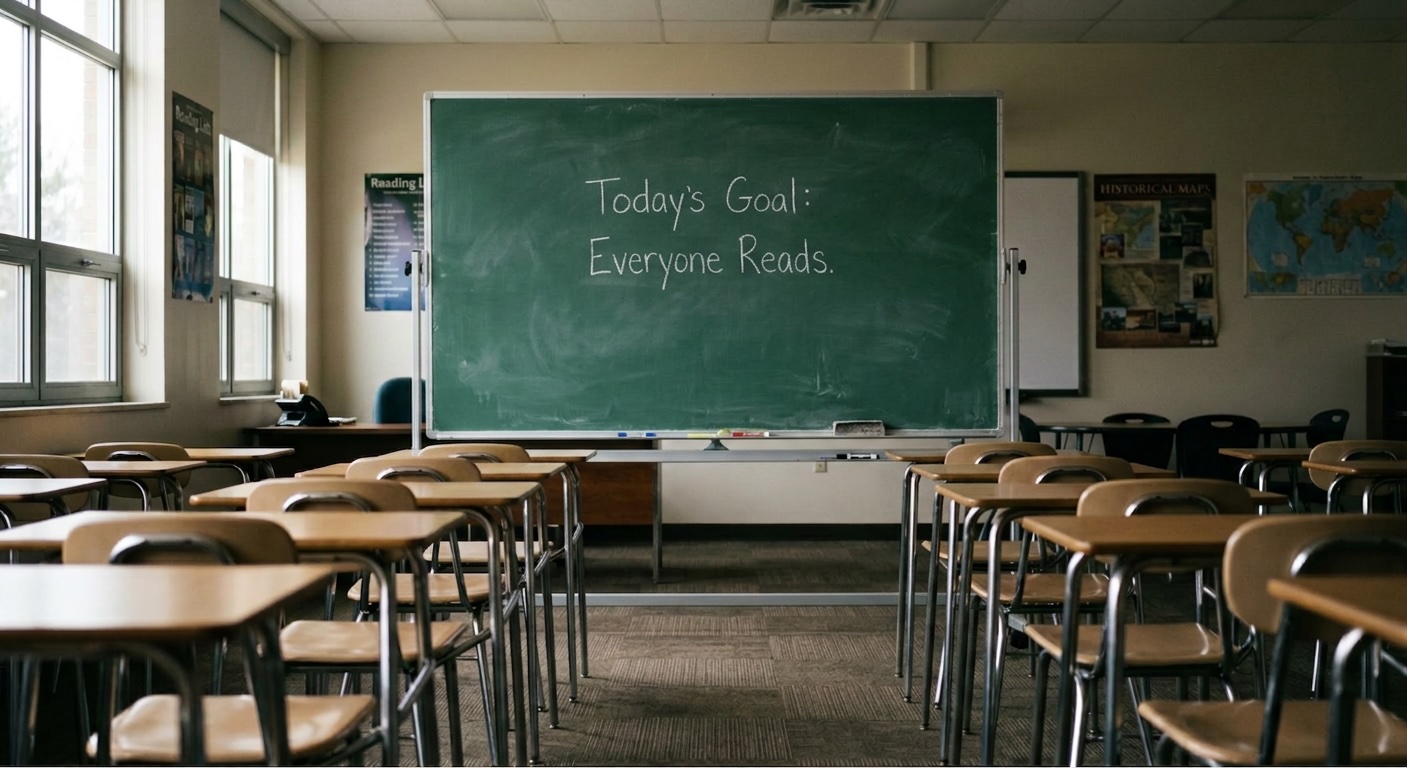
“The ruler moved,
not the reading.”
Kansas fell from 5th to 36th in reading. Here’s how to reverse it.
“The ruler moved,
not the reading.”
In 2013, Mississippi ranked 49th out of 50 states in fourth-grade reading. Kansas ranked 5th. A decade later, Mississippi had climbed to 9th — the largest improvement of any state. Kansas had fallen to 36th.
Same decade. One state organized everything around a single goal and rose. The other had every advantage and drifted.
Everyone in Topeka knows Kansas reading scores are bad. What gets less attention is that a decade ago they were among the best in the country.
What separates a state that rose from one that drifted? Not money: Kansas spends more per pupil than Mississippi by a significant margin, among the ten highest states nationally when adjusted for cost of living. Not demographics: Kansas has fewer of the structural disadvantages Mississippi had to overcome. The difference is simpler and harder: one state decided what it was for, and the other never quite did.
Kansas State Treasurer Steven Johnson recently raised a version of that point with me, pointing to a Harvard Business School case study on Southwest Airlines. Southwest’s original strategy worked because every decision answered the same question: Does this make us the lowest-cost, most reliable short-haul airline? Once that question was fixed, the decisions got easier: one aircraft type, point-to-point routes, fast turnarounds. Competitors could copy any one of those choices. They couldn’t copy the clarity.
What happened next is also instructive. Over time, Southwest became more complex, and the strategic discipline that had set it apart weakened. The original strategy hadn’t failed. The company had drifted from the original strategy.
Kansas education has followed a similar path. A system that once ranked fifth in the country kept adding priorities until it lost sight of the question it exists to answer.
A mission with no edges is a budget with no bottom. Kansas doesn’t need ten new priorities. It needs one obsession, with everything else built to reinforce it.
One essay like this, every week.
Subscribe free to read on.
Already subscribed? Click to continue reading.
Every other subject depends on reading. A child who can’t read by third grade doesn’t just fall behind in reading — math instructions get harder to follow, history becomes memorization instead of a story, science textbooks turn into decoding puzzles, and the ordinary business of adult life becomes harder to navigate independently.
Third grade is the hinge: the point at which reading stops being the subject and becomes the tool for learning everything else. The argument for obsessing over it isn’t that reading matters more than chemistry or history. It’s that chemistry and history become dramatically harder to teach to a child who can’t yet read them. Students who aren’t reading proficiently by the end of third grade are roughly four times more likely to leave high school without a diploma. The share of fourth graders who can’t read at even a basic level has risen every cycle since before the pandemic: 34 percent in 2019, 37 percent in 2022, 40 percent in 2024, the worst showing in more than two decades.
Reading isn’t the only thing schools should teach. But it’s the one thing that makes everything else teachable.
Mississippi didn’t pass one miracle law. It aligned several ordinary things around a single target: every child reading proficiently by the end of third grade. It built a curriculum around the actual science of reading rather than the methods that had been used for decades without evidence. It provided coaching for teachers instead of just mandates. It created accountability that named results and transparency that let parents see them.
Every lever pointed at the same goal. And even though math scores were never directly targeted, they rose anyway — exactly the way a single clear synergistic goal is supposed to work. Mississippi has focused on one objective while Kansas was accumulating objectives. The lesson isn’t Mississippi. The lesson is focus.
Kansas came close to getting this right. It built a serious, bipartisan literacy plan — the Blueprint for Literacy, passed with broad support in 2024, to retrain teachers in the science of reading. Teachers signed up faster than the program could accommodate them. But in the 2025 session, in a compressed budget process that left little room for anyone to make the case for it, the funding disappeared.
Kansas started. Kansas stopped. That’s what it looks like when literacy is a priority rather than the priority.
Before Kansas debates another funding formula, it ought to ask a simpler question: how many children learned to read well enough that reading stopped being the subject and became a gateway to every other subject?
Parents shouldn’t need to navigate a state website, a spreadsheet, or a consultant to find out if their child’s school is working. Every school should be able to answer three questions, out loud, every year: How many third graders read at grade level? Is that number improving? What are you doing about it?
And the answer should arrive in a form every parent already understands: a letter grade. Not a hundred-page report card or a color-coded dashboard with fourteen weighted sub-indices — an A through F, per school, built primarily on whether children are learning to read and whether that number is climbing. Florida and Mississippi both grade their schools this way, and the grade does something no spreadsheet does: it tells a parent, a realtor, and a school board the same thing at a glance. It also makes improvement or decline impossible to hide.
Which is why the state should anchor its public reporting to the national test rather than its own. Kansas already changed the test, and the number, when the number turned unwelcome. After years of falling scores on its state reading test, the State Board of Education introduced a new exam in 2025. Proficiency promptly jumped — in some grades nearly double what it was the year before.
The ruler moved, not the reading.
Once literacy is the standard, bureaucracy becomes easier to reform, because every rule finally has a clear test: does it help a child learn to read?
Two disciplines follow from that test. First, every program should have to periodically demonstrate either that it improves student learning directly or that it supports the people who do — or it should sunset. Second, Kansas’s nearly 290 districts should stop running 290 separate back offices for the same state and federal paperwork — not by consolidating the districts themselves, but by pooling the administrative work behind them. Administration is not the mission. It is merely the support structure, and the support structure should run as efficiently as possible so more money and time reach the classroom.
Choice is the other lever, and it matters for the reason the second essay in this series gave: competition is the pressure that keeps an institution honest. But it is not Kansas’s whole answer. Large parts of rural Kansas have no second school within an hour’s drive, and no policy conjures one where only one exists. Nor does choice eliminate bureaucracy on its own — public dollars to private schools will inevitably come with public strings for any private school that takes them, creating the same regulatory and reporting burden on private schools that have calcified around public schools.
So, choice belongs in the toolbox. But it’s not the toolbox.
A decade ago Kansas had one of the strongest elementary reading records in the country. It has spent the years since adding priorities, changing tests, and watching the number fall. Not because its teachers are worse or its children less capable. Because no one ever decided that a single number was the one thing the system would be judged by — and a system asked to succeed at everything tends to succeed at nothing.
Mississippi decided. Kansas still can.
Josh Dambacher is a fifth-generation Kansan who attended public schools in Kansas, is on the Board of Literacy Partners, and writes The Plains Ledger.
— J.D.
Economics, law, policy, and capital — delivered free, every week.
Subscribe to The Plains Ledger